







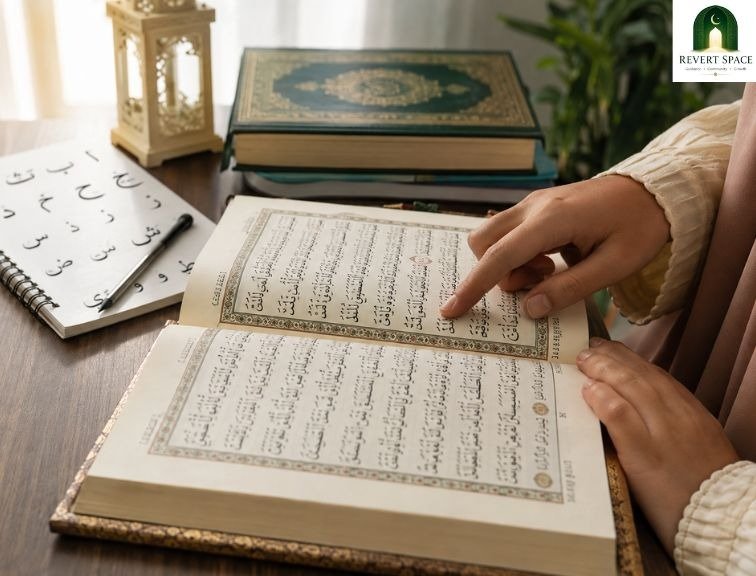
Many new Muslims describe the same moment. They pick up the Quran, open it, and feel something between longing and overwhelm. The script is unfamiliar. The letters flow in a direction they have never read before.
And yet they know, with complete certainty, that this is the book they want to read.
If that is where you are, this guide is for you. Learning to read the Quran for beginners is not as distant as it first appears. With the right sequence and consistent practice, most new Muslims are reading their first complete Surah within weeks.
Where Everyone Begins: The Arabic Alphabet
The Quran is written in classical Arabic. Before you can read it, you need to recognise Arabic letters, know how each sounds, and understand how they connect when written together.
There are 28 letters in the Arabic alphabet. Each has up to four written forms depending on its position in a word. That sounds complex. In practice, the patterns become familiar quickly once you work through them in sequence.
Resources like the Noorani Qaida are very useful as a starting point, laying a strong foundation in Arabic letter recognition before progressing to Quranic recitation. The Noorani Qaida is a structured primer used by millions of learners worldwide precisely because it introduces letters in a sequence that builds naturally toward actual Quran reading.
Did You Know? Over 80% of Quran readers worldwide are non-native Arabic speakers who have successfully learned to read and recite through structured methods. You are not learning something rare or unusually difficult. You are joining the majority of Muslims who came to the Quran from exactly where you are.
Understanding Tajweed: What It Is and Why It Matters from the Start
Tajweed is the science of reciting the Quran correctly and beautifully. It covers the proper pronunciation and articulation of Arabic letters and words . For a beginner: do you need Tajweed rules before you start reading?
Yes. But not all of them at once.
You do not need advanced Tajweed at the beginning. Start with the letters. Fix your pronunciation first. Then learn four core rules. Then practice. Then get correction.
The word “qalb” (heart) becomes “kalb” (dog) with one small pronunciation mistake. Arabic is precise. Small errors change meaning. Learning correct articulation from the start means you are not building habits that need correcting later.
Every new reader should learn these Tajweed basics early:
- The correct articulation point (Makhrij) of each letter, meaning where in the mouth or throat the sound originates
- Short vowels (Harakat): the three basic vowel marks that tell you how a letter is pronounced
- Sukun: the mark that indicates a letter has no vowel sound
- Madd: the rules of elongation, which tell you when to hold a sound longer
These are manageable. They are learned alongside the letters themselves, which is exactly how the Revert Space Qur’an Reading Program structures the journey.
Your First Surahs: Where to Actually Start Reading
The best way for a beginner to build confidence is to start with the shortest chapters of the Quran, found at the very end in the section known as Juz’ Amma. These chapters are brief, easier to memorise, and often have a clear, powerful rhythm.
Begin with Surah Al-Ikhlas, Surah Al-Falaq, and Surah An-Nas. These are chapters that Muslims recite daily in their prayers, so learning to read them has an immediate practical benefit.
This matters enormously for new Muslims. The moment your reading connects to your Salah, everything changes. You are no longer learning an abstract skill. You are reading the words you say to Allah five times each day.
Start with Al-Fatiha. Seven verses. Recited in every unit of every prayer. Every Muslim who knows it, at some point, did not.
Expert Insight: Based on supporting new Muslims through the Qur’an Reading Program, the learners who progress most consistently connect their reading practice to Salah from the beginning. Working with the Surahs you already hear in prayer makes every session feel purposeful. Learning disconnected from worship takes far longer to embed.
Common Mistakes Beginners Make (and How to Avoid Them)
- Rushing through letters. The Arabic alphabet stage feels slow. It is not. Every minute here is repaid when recitation begins.
- Skipping a teacher. Audio resources help but cannot correct your pronunciation. Students with weekly one-on-one sessions achieve proper Tajweed three times faster than self-study students. A teacher who hears you is not a luxury. It is the fastest route to accurate reading.
- Starting with long Surahs. Al-Baqarah is the longest chapter in the Quran. It is not for beginners. Start short, finish completely, and let the sense of completion carry you forward.
- Practising too infrequently. Fifteen minutes daily produces far more progress than an hour once a week. Daily practice is not optional if you want to actually read.
How Revert Space Supports Your Quranic Reading Journey
The Revert Space Qur’an Reading Program is built for new Muslims who have never encountered Arabic script before. It moves step by step from letter recognition to reading complete Surahs, with structure that fits naturally into daily life.
The program is free, self-paced, and connected to the full Revert Space support network:
- The Arabic for Beginners course for deeper language foundation
- Daily Practice Coaching to connect your reading progress to your Salah
- One-to-one mentorship for personalised guidance on pronunciation and Tajweed
- Revert Support Circles where you can share the journey with other new Muslims working through the same stages
No prior knowledge is needed. No Arabic background is assumed. The only requirement is the willingness to begin.
Reading the Quran Is Not a Destination. It Is a Daily Act.
The goal is not a moment when you finish. It is a relationship that develops over years of daily practice and growing familiarity with the words of Allah.
Every new Muslim who reads even a single letter with genuine effort is rewarded for that effort. The slowness at the beginning is not failure. It is the beginning of something that will stay with you for life.
Start with one letter today. Register at Revert Space and let the Qur’an Reading Program walk you through every step from exactly where you are.
META DESCRIPTION
New to Islam and want to read the Quran? This beginner-friendly guide covers every step, from Arabic letters to first Surahs. Start free at Revert Space today.




Bài viết rất hữu ích, cảm ơn đã chia sẻ! Letco là công ty tư vấn du học Hàn Quốc uy tín, hỗ trợ trọn gói từ hồ sơ, visa đến học bổng. Tham khảo thêm tại letco.vn nhé.